How to Stop Revenge Trading: 7 Proven Techniques

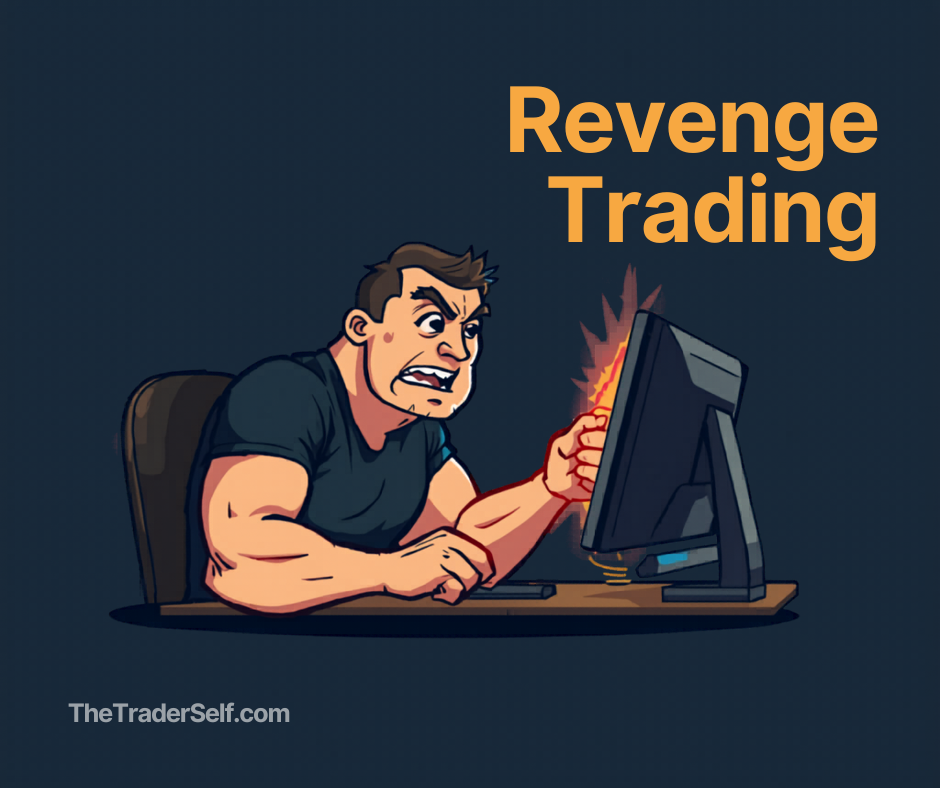
Knowing how to stop revenge trading is one of the most important skills a trader can develop, because nothing destroys an account faster than emotional re-entry after a loss. You take a loss, and instead of stepping back, something shifts inside you.
The trade is closed but your mind is still in it, still arguing with the market, still trying to prove something. So you open another position almost immediately, sometimes without even looking at the chart properly, and the only real reason is that you want the money back.
That is revenge trading.
It is not a strategy. It is not analysis. It is an emotional response dressed up as a trade.
Most traders have done it at some point. The ones who keep doing it are the ones who never understood what was actually happening beneath the surface when they hit that buy or sell button again.
If you are not familiar with how emotions drive trading decisions at a deeper level, What Is Trading Psychology covers the full picture.
What Is Revenge Trading?
Revenge trading is when a trader re-enters the market after a loss not because a valid setup has appeared, but because they are trying to recover money they just lost.
The emotional need to get back to breakeven overrides every rule, every plan, and every piece of analysis they would normally rely on.
It is one of the most common and costly patterns in retail trading. And it almost always follows the same emotional sequence, which means it can be interrupted once you understand where in that sequence you actually are.
The name says it all. The trader is not trading the market. They are trying to get revenge on it.
Why Your Brain Pushes You Into It
Here is the part most trading content skips over. Revenge trading is not a discipline problem on its own.
It is a psychological response to loss aversion, a deeply wired human tendency to feel the pain of losing more intensely than the pleasure of winning.
Behavioural finance research has consistently shown that the pain of a financial loss is felt roughly twice as intensely as the pleasure of an equivalent gain.
That asymmetry is what makes sitting with a loss so uncomfortable that the brain immediately pushes toward action.
When you take a loss, your brain does not process it the way a spreadsheet does. It registers it as a threat. And the fastest way your brain knows how to deal with a threat is to act, to do something, anything, to neutralise the discomfort as quickly as possible.
Re-entering the market feels like action. It feels like taking control back. It feels like solving the problem.
But the market does not care that you are trying to recover. It will not give you your money back because you want it urgently. And urgency in trading almost always costs more than the original loss.
The revenge trade is not really about the market. It is about how unbearable you find sitting with a loss.
The Pattern Every Revenge Trader Recognises
It usually goes like this. You lose. The loss stings more than it should based on the size. You feel like the setup was right and the market was wrong, even if intellectually you know that thinking makes no sense. You watch the market move and it looks like it is setting up again.
You tell yourself this next one is a real trade, a proper setup. You enter. It goes against you too. Now you are down twice as much and the emotional weight is twice as heavy.
Some traders stop there. Others go again.
By the third or fourth trade in this cycle, the position sizing has often gone up because the brain is now calculating how much it needs to recover, not how much risk is appropriate. That is where accounts start to break down seriously.
The pattern is not random. It follows the same emotional logic almost every time. Which means it can be interrupted, but only if you understand where in the sequence you actually are.
7 Techniques to Stop Revenge Trading
1. Recognise the Emotional State Before You Act
The most important intervention happens before you enter the trade. If you have just closed a loss, your emotional state is not neutral. It never is. The question is whether you are aware of it or not.
Build a habit of pausing after every loss, even a small one, and asking yourself one honest question: am I about to trade because the setup is genuinely valid, or because I want my money back?
You will know the answer. Most traders know it in the moment. They just choose to override it.
2. Set a Hard Rule: No Trading for 15 Minutes After a Loss
This sounds simple. It is simple. But simple is not the same as easy.
The 15-minute rule creates space between the emotional reaction and the next decision. That space is where discipline lives. You do not have to analyse anything in those 15 minutes. You just have to not trade. Step away from the screen. Get water. Do something physical. Let the cortisol drop.
The market will still be there when you come back. The setup you think you are missing almost certainly was not as good as it looked in that emotional state.
3. Use a Daily Loss Limit and Respect It Like a Rule, Not a Suggestion
Decide before the trading day begins: if I lose X amount today, I am done. Not pausing. Done.
The number should be based on your account size and your normal risk per trade. If you lose two or three normal trades in a day, that is a losing day. It happens. What should not happen is a normal losing day turning into an account-damaging session because you kept going trying to fix it.
The daily loss limit is one of the most protective rules in trading. Most traders know they need one. Fewer actually follow it when the emotions are running.
4. Write Down What You Are Feeling Before You Re-Enter
This one works specifically because it slows the process down and forces articulation. Before you enter a trade after a loss, write one sentence in your trading journal: why am I taking this trade right now?
If the honest answer involves the word recover or get back or prove, close the journal and close the platform. That trade should not happen.
If you genuinely cannot write a clean trade rationale based on what the chart is showing, that tells you everything you need to know.
5. Reduce Position Size After a Loss, Not Increase It
The instinct after a loss is often to trade bigger to recover faster. This is the most dangerous part of the revenge trading cycle because it changes the math permanently. A 2% loss followed by a 4% loss followed by a 6% loss is not three bad trades. It is an account in serious trouble.
The rule should be the opposite. After a loss, reduce your position size for the next trade. Trade smaller, not larger. This keeps you in the game and removes the pressure of needing any single trade to perform.
6. Review the Loss, But Not Immediately
There is value in reviewing a losing trade. Understanding what happened, whether the setup was genuinely valid or whether you broke your own rules, is how you improve over time.
But that review should not happen in the 10 minutes after the trade closes. In that window you are not reviewing. You are rationalising. You are building a case for why you should trade again right now.
Leave it until the end of the session, or the next day. Give the emotional charge time to settle before you try to learn anything useful from it.
7. Track Your Revenge Trades Separately
If you already have a trading journal, start tagging trades that were taken in emotional recovery mode. Not to punish yourself for them, but to see the data.
Most traders who do this discover the same thing within a few weeks: their revenge trades have a dramatically worse win rate and a worse risk-reward outcome than their planned trades. Not slightly worse. Significantly worse.
Seeing that pattern in your own data is more convincing than any rule you set for yourself in the abstract. The numbers make the argument your discipline alone cannot always make in the moment.
Why a Trading Journal Changes Everything
The common thread through most of these techniques is awareness, catching yourself in the emotional state before it drives the decision. And the tool that builds that awareness faster than anything else is a trading journal.
Not a spreadsheet that tracks your P and L. A proper journal that records what you were feeling before the trade, why you took it, and how you felt after. One that shows you your psychological patterns over time, not just your financial ones.
Building awareness of your emotional patterns is something covered in detail in How to Control Emotions While Trading. It gives you the full system for recognising and managing every emotional state that shows up in your sessions, not just revenge trading.
Tools like Edgewonk and TraderSync are built specifically for this. They let you tag the emotional state behind each trade, track your performance by session type, and surface patterns in your behavior you would never notice just by looking at charts.
If you are serious about stopping revenge trading, the journal is where that work actually happens. Everything else is rules. The journal is evidence.
FAQ
What is the difference between revenge trading and normal re-entry? A normal re-entry is based on a valid new setup that appears after a loss. The decision comes from what the chart is showing.
Revenge trading is driven by the desire to recover money, not by market conditions. The emotional state behind the decision is the real difference, not the trade itself.
Why do experienced traders still revenge trade? Because the emotional trigger is not based on experience level. It is based on how a person responds to loss aversion.
Experienced traders have better awareness of the pattern and stronger rules to interrupt it, but the emotional pull does not fully disappear. It gets managed, not eliminated.
Does revenge trading always lose money? Not always. Sometimes a revenge trade wins, which is actually one of the reasons the pattern persists.
The occasional win reinforces the behavior. But across a large enough sample of trades, revenge trades almost universally underperform planned trades in both win rate and risk-reward.
How long does it take to break the revenge trading habit? It varies, but most traders who actively track and work on it see meaningful improvement within 60 to 90 days of consistent journaling and applying a daily loss limit.
The pattern does not disappear, but the response time between the emotional trigger and catching yourself gets faster.
Is revenge trading a sign I should stop trading? Not necessarily. It is a sign that your emotional relationship with loss needs work, which is true for most traders at some point.
The traders who stop experiencing it are not the ones who stopped trading. They are the ones who did the psychological work to understand what was driving it.
Final Thoughts
Revenge trading is not a willpower problem. It is not a strategy problem. It is what happens when the emotional response to a loss is stronger than the structure you have built to contain it.
The market is not doing anything to you. It is just moving. Your reaction to that movement, the urgency, the need to recover, the inability to sit with a loss, that is where the real work is.
Most traders don’t lose because they can’t read the market. They lose because they can’t read themselves.
The seven techniques in this post are not magic. None of them work if you only apply them when you feel like it. But applied consistently, especially the journal, the daily loss limit, and the 15-minute pause, they will change your relationship with losing trades in a way that compounds over time.
Not because you will stop feeling the loss. But because the feeling will stop making the decision for you.
Track your emotional trading patterns with Edgewonk and TraderSync, both built specifically to help traders understand their psychological behavior, not just their P and L.