Fear and Greed in Trading: What They Really Cost You

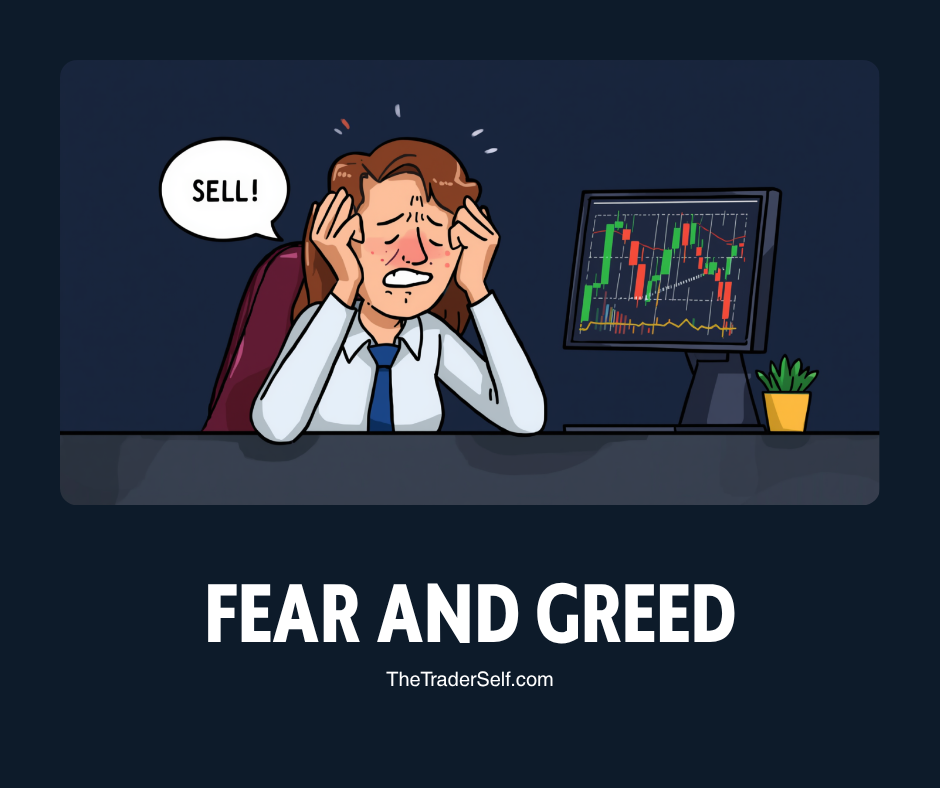
Fear and greed in trading are the two forces every trader has heard about and almost none truly understand at the level that would actually change their behavior.
Most traders nod when they hear the phrase. They agree it applies to other people. They move on and go back to looking for a better entry.
And the whole time, both emotions are sitting in every decision they make, shaping their results in ways they cannot see because they never looked closely enough.
This is not a post about concepts. It is a post about the specific moments fear and greed show up inside a trading session, what they feel like from the inside, and what they actually cost over time.
If you understand how psychology shapes every decision you make in the market, What Is Trading Psychology gives you the full foundation this post builds on.
Why Fear and Greed In Trading Are More Than Just Trading Cliches
The phrase fear and greed gets used so often in trading that it has almost lost its meaning.
It gets mentioned in every beginner course, referenced in every trading book, and repeated so frequently that most traders file it away as something they already understand and never look at again.
But understanding that fear and greed exist is not the same as understanding how they operate inside your specific decision making.
And that gap, between knowing the concept and recognising it in real time, is where most of the damage happens.
Fear and greed are not abstract market forces. They are neurological states that change how you process information, how you assess risk, and how you execute decisions.
When fear is present, your brain overweights the probability of loss and underweights the value of patience. When greed is present, your brain overweights the potential of gain and underweights the risk of staying in too long.
Neither state produces clear thinking. Both feel completely rational from the inside. That is what makes them so consistently costly.
The fear and greed index measures the collective emotional state of market participants at any given moment. But the fear and greed that matters most to your trading results is not the market’s. It is yours. The internal version. The one that is running quietly in the background of every trade you take.
The Many Faces of Fear Inside a Trading Session
Most traders think of fear as one thing. The sweaty palms before a big trade. The anxiety during a losing streak.
But fear in trading operates in multiple forms, and some of them are so subtle that traders experience them every session without ever labelling them as fear.
Fear of losing money is the obvious one. It shows up as exiting winning trades too early because the brain cannot tolerate watching an open profit potentially disappear.
The trade is still valid. The target has not been reached. But the fear of losing what is already there overrides the plan and the exit happens before it should.
Fear of being wrong is quieter but just as damaging. This is the fear that keeps traders from cutting losing trades when they should. Closing a trade at a loss means admitting the analysis was wrong.
For many traders that admission feels worse than the financial loss itself. So the stop loss gets moved. The losing position gets held. And what started as a manageable loss becomes a significant one.
Fear of missing out is fear disguised as urgency. A pair breaks out strongly, a move is happening right now, and the brain registers it as an opportunity that is slipping away. The entry happens late, at a poor price, without the conditions the trading plan requires.
And when the move reverses, as it often does after a strong impulsive break, the trader is immediately deep in a loss they took on out of fear, not analysis.
All three versions of fear have one thing in common. They feel like reactions to the market. They are actually reactions to uncertainty.
As covered in How to Control Emotions While Trading, the market is not doing anything to you. Your emotional response to what it is doing is where the real cost lives.
How Greed Operates and Why It Is Harder to Spot Than Fear
Fear is uncomfortable. Most traders can feel it even if they cannot always name it. Greed is different.
Greed almost never announces itself as greed. It arrives wearing the clothes of confidence, opportunity, and justified optimism.
After a run of winning trades, something shifts. The edge starts to feel stronger than it actually is. The next setup looks cleaner than it really is.
The risk seems more manageable than it genuinely is. None of these shifts feel like greed in the moment. They feel like earned confidence from a period of good results.
This is exactly what makes greed so dangerous. It erodes the rules that protect you without triggering the discomfort that would cause you to notice.
The daily loss limit gets bent, not broken, just adjusted slightly because today feels different. The position size increases, not dramatically, just a little more than normal because the conviction is high.
The profit target gets moved further away because the trade is running well and surely it has more in it.
Each of these decisions feels reasonable in isolation. Stacked together across a session or a week, they represent a complete abandonment of the process that produced the winning streak in the first place.
Then a large loss arrives. And it is larger than it should be because the position size was bigger than the plan allowed. And the winning streak’s gains start disappearing in a way that feels sudden but was actually inevitable.
Greed does not blow accounts in one dramatic moment. It quietly removes all the protections that were keeping the account safe until one normal losing trade causes abnormal damage.
That is where overtrading and its connection to greed becomes one of the most important patterns to understand after this one.
The Fear and Greed Cycle and Where Most Traders Get Trapped
Fear and greed do not operate independently. They follow a cycle that most traders will recognise immediately once it is described clearly.
It starts with a loss. Fear activates. The trader becomes cautious, hesitates on valid setups, exits trades earlier than their plan requires.
Results suffer not because the strategy stopped working but because the execution became fearful and inconsistent.
Then a trade works. And another. The fear starts to recede. Confidence builds. Execution improves because the emotional state has stabilised.
Results improve. This is the sweet spot. Calm, process-driven trading producing consistent outcomes.
But if the winning run continues long enough, the confidence tips into overconfidence. Greed starts operating. Rules bend. Position sizes grow.
The process that produced the winning run gets quietly replaced by the emotional state the winning run created.
Then a loss arrives at an inflated position size. The loss is larger than normal. Fear returns. Sometimes it comes back harder than before because this time the account has taken more damage. The cycle starts again.
Most traders spend their entire trading career cycling through this pattern without ever naming it clearly enough to interrupt it.
They experience the results, the inconsistency, the frustrating alternation between periods of discipline and periods of recklessness, without connecting it to the underlying emotional cycle driving all of it.
Naming the cycle is the first step to stepping outside it.
How to Use Fear and Greed as Information Rather Than Fighting Them
Here is the perspective shift that separates traders who have genuinely worked on their psychology from those who are still trying to suppress their emotions through willpower alone.
Fear and greed are not just problems to manage. They are information.
Your fear before a trade is worth examining. Is it the generalised anxiety that comes from being in an uncertain environment? That fear is noise. It does not contain useful information about this specific trade.
But is it a more specific discomfort, a sense that something about this setup does not quite align with your rules even though you cannot immediately articulate why?
That fear might be worth listening to. Experienced traders learn over time to tell the difference between the two.
Greed is similar. The feeling that a trade has more to give can sometimes be accurate. Context matters. A trade running strongly in a clear trend with no structural resistance overhead is different from a trade at an extended level in a choppy market.
The greed impulse to stay in is not always wrong. The problem is that greed removes the analysis from the decision and replaces it with desire.
The goal is not to eliminate these emotions. It is to create enough space between the feeling and the decision that you can examine what the emotion is actually telling you before you act on it.
Tools like Edgewonk and TraderSync help make this practical by allowing you to tag the emotional state behind each trade and track which emotional conditions produce your best and worst results over time.
Patterns that are invisible in the moment become clear across hundreds of tagged trades. You start to see exactly when your fear is costing you exits too early, and exactly when your greed is keeping you in too long.
That data changes how you respond to both emotions permanently.
FAQ
What is the role of fear and greed in trading? Fear and greed are the two primary emotional forces that influence trading decisions. Fear causes traders to exit winning positions too early, hold losing positions too long, and hesitate on valid setups.
Greed causes traders to hold past profit targets, increase position sizes beyond their plan, and take lower quality setups during winning streaks.
Both distort decision making in ways that feel rational in the moment but are clearly visible in the data over time.
How do fear and greed affect trading decisions? They affect every layer of execution. Entry timing, position sizing, stop loss placement, profit target management, and the decision to continue or stop trading for the day are all influenced by the emotional state the trader is in.
A trader experiencing fear and a trader experiencing greed will make fundamentally different decisions from the same setup, often with significantly different outcomes.
Which is more dangerous in trading, fear or greed? Both cause significant damage but in different ways. Fear tends to cause consistent underperformance because it prevents traders from following their plan accurately.
Greed tends to cause sporadic but severe damage because it removes the protections that limit losses during inevitable drawdowns.
Over a long enough time frame, greed is often the more destructive of the two because its damage is concentrated rather than spread out.
How do you control fear and greed when trading? The most effective approach is structural rather than psychological.
Set rules before the session begins that account for both emotions: a daily loss limit addresses fear-driven revenge trading, a maximum position size rule addresses greed-driven oversizing, and a mandatory pause after any significant loss addresses the fear-greed transition that leads to the cycle described above.
Tracking emotional states in a trading journal over time builds the self-awareness that makes these rules easier to follow.
What is the fear and greed cycle in financial markets? The fear and greed cycle describes the alternating emotional states that drive market participant behavior over time.
Fear dominates during periods of loss and uncertainty, causing excessive caution and missed opportunities.
Greed dominates during periods of gain and momentum, causing excessive risk-taking and rule-breaking.
Most traders oscillate between these states in their own accounts, mirroring the same cycle that plays out at the broader market level.
Final Thoughts
Fear and greed will be present in your trading for as long as you trade. That is not a problem with a solution. It is a reality with a framework.
The traders who navigate these emotions well are not the ones who feel them less.
They are the ones who have built enough self-awareness to recognise which emotion is running at any given moment, enough structure to protect their decisions from the worst impulses of both, and enough honesty to review their own data and see the patterns clearly.
Fear tells you the market is uncertain. It always is. Greed tells you the opportunity is there. It often is. Neither tells you what to actually do. That is what your process is for.
The market is not exposing your strategy. It is exposing your emotional weaknesses. Understanding fear and greed at the level this post describes is how you start turning that exposure into genuine self-knowledge rather than just repeated losses.
Tracking the emotional context behind your trades is how fear and greed stop being invisible forces and start becoming readable patterns. Edgewonk and TraderSync are built specifically for this kind of psychological trade logging.