How to Control Emotions While Trading: A Honest Guide

Learning how to control emotions while trading is something almost every trader struggles with, yet most go about it in completely the wrong way. They think the solution is to try harder. To be stricter with themselves.
To want discipline badly enough that it finally sticks. So they set new rules, they make new commitments, and for a few sessions it works. Then a difficult trade arrives, or a losing streak builds up, and everything they committed to quietly disappears.
The problem is not effort. The problem is that they are trying to solve an emotional issue with a willpower solution, and those are two completely different things.
Learning how to control emotions while trading is not about suppressing what you feel or forcing yourself to stay calm through sheer determination.
It is about understanding the specific emotional patterns that appear in your trading, recognizing them early enough to interrupt them, and building a structure around your sessions that accounts for those patterns before they get the chance to make your decisions for you.
This post builds directly on what was covered in What Is Trading Psychology and Why Most Traders Never Master It. If you have not read that yet, it gives useful context for everything here.
Why Emotional Trading Is Not a Willpower Problem
The reason willpower fails traders consistently is that willpower is a limited resource. It depletes under stress, uncertainty, and repeated decision making.
The market produces all three of those things in every single session. Relying on willpower alone to manage your emotions while trading is like trying to run a marathon on one hour of sleep because you are determined enough.
What actually drives emotional trading is not weakness. It is a predictable neurological response to the environment the market creates.
Every open position is an unresolved financial outcome sitting in real time. Your brain registers that uncertainty as a low level threat, and under threat conditions the brain defaults to instinctive responses rather than rational ones.
It wants to resolve the uncertainty quickly. It wants to act. And in trading, acting quickly from an emotional place is almost always the wrong move.
This is backed by decades of behavioural finance research. Nobel Prize winning economist Daniel Kahneman’s work on loss aversion demonstrated that humans feel the pain of a loss roughly twice as intensely as the pleasure of an equivalent gain.
That single psychological bias plays out in trading accounts every single day, in every market, at every experience level.
The trader who exits a winning trade 20 pips early is not weak. Their brain is taking a guaranteed small reward over an uncertain larger one, which is exactly what brains are wired to do.
The trader who holds a losing position past their stop loss is not stupid. Their brain is avoiding the pain of confirming a loss, which is also exactly what brains are wired to do.
These are not character flaws. They are predictable responses to a specific set of conditions. And because they are predictable, they can be prepared for. That is the entire basis of emotional control in trading. Not suppression. Preparation.
The Four Emotions That Decide Most Trading Outcomes
Understanding which emotions are actually driving your decisions is the first practical step toward controlling them. There are four that appear consistently across every market and every experience level.
Fear
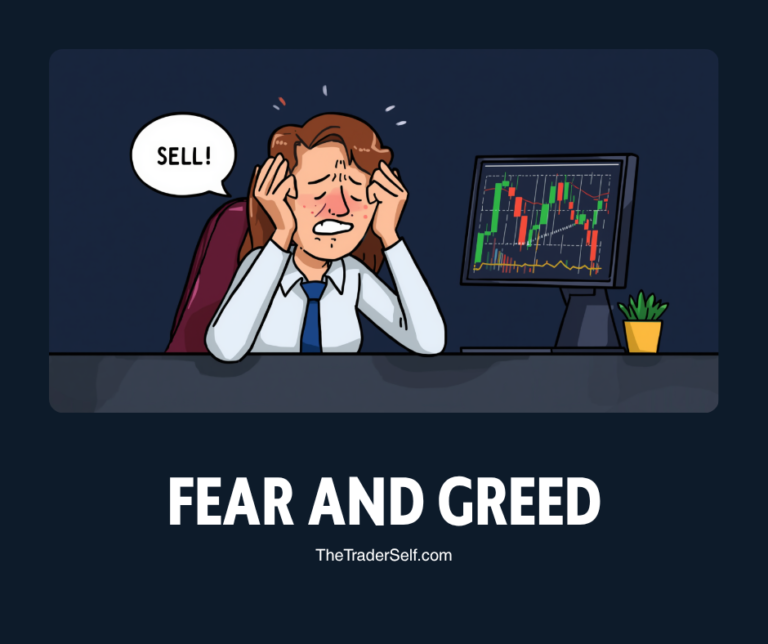
Fear in trading shows up in more ways than most traders realise. There is the obvious fear of losing money, which causes traders to exit winning positions too early because they cannot bear to watch a profit disappear.
But there is also fear of being wrong, which causes traders to move stop losses further from price rather than accepting that a trade has failed. And there is fear of missing out, which pulls traders into entries they would never normally take because a move is happening and the brain registers it as an opportunity disappearing.
All three versions of fear produce decisions that feel rational in the moment and look irrational the moment the session is over.
Beyond fear, greed is the second force that shapes trading outcomes. Greed is less obvious than fear because it often disguises itself as confidence. A trader on a winning streak starts to feel like they have figured something out. The edge feels stronger than it actually is.
Position sizes increase. Rules about when to stop for the day get ignored. The trader stays in a trade well past their target because they are convinced the move has more in it.
Greed rarely feels like greed while it is happening. It feels like opportunity.
Closely linked to greed, overconfidence arrives after a period of good results. A run of winning trades creates a distorted sense of certainty. The trader starts taking setups they would have passed on two weeks ago because their recent record makes them feel untouchable.
They start believing their judgment is sharper than their process, and they start trading their opinion rather than their system.
One large, poorly managed loss in this state can erase weeks of carefully built gains.
Finally, frustration is the quietest of the four. It builds across a session or a week. It comes from a series of stopped out trades, from watching a setup that met all your criteria fail twice in a row, from missing a move because you hesitated.
The danger of frustration is that it rarely announces itself loudly. It just gradually lowers the threshold at which you take trades. Standards slip. Setups that would normally be rejected start looking acceptable.
Each of these four emotions has a specific signature in your trading behavior. The goal is not to eliminate them. It is to learn to recognise that signature early enough to pause before it becomes a decision.
How to Recognise Your Emotional State Before It Costs You Money
Recognition is the skill that everything else is built on. You cannot interrupt an emotional response you have not noticed yet.
The most reliable way to develop this skill is to build a pre-session check in as a non-negotiable part of your trading routine.
Before you look at a single chart, before you open your platform, you spend two minutes asking yourself one honest question. How am I actually feeling right now and what am I bringing into this session?
This sounds almost too simple to be useful. It is not. Most traders sit down to trade in whatever emotional state they happen to be in, carrying whatever happened in the previous session or the previous day, and they start making financial decisions from that state without ever acknowledging it exists.
A trader who sits down after a losing week and does not acknowledge that they are carrying frustration and a need to recover is a trader who is already vulnerable.
The emotional state is there whether they notice it or not. The only difference is whether they are aware of it in time to account for it.
The second layer of recognition happens during the session itself. This is harder because the emotional response and the trading decision often happen almost simultaneously.
The way to create separation between them is to introduce a mandatory pause before any trade execution. Before you click the button, you state out loud or write down in one sentence why you are taking this trade. Not what the setup is. Why you are taking it right now.
If the honest answer to that question involves wanting to recover something, proving a point, or acting on urgency rather than clarity, that trade should not happen.
Building a Process That Controls Emotions Before They Control You
Rules built around your specific emotional tendencies are worth more than any mindset tip you will ever read.
The goal is to remove as many in-the-moment decisions as possible and replace them with pre-made commitments that do not require willpower to follow because they are already decided.
A daily loss limit is the most important of these. Decide before the session begins what the maximum loss is for the day. When that number is hit, the session ends. Not pauses. Ends.
This single rule prevents the most common and costly emotional sequence in trading, which is a normal losing day turning into an account-damaging session because the trader kept going trying to fix it.
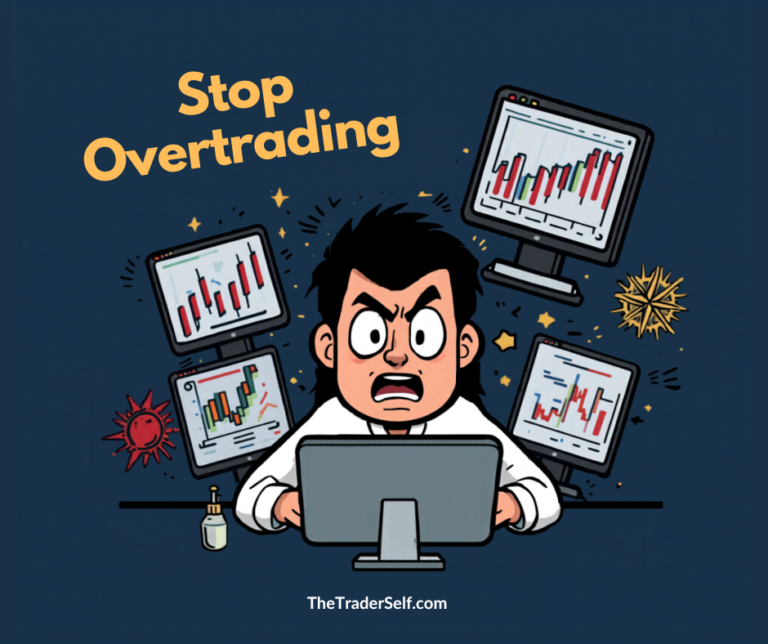
A maximum trade count per session serves a similar purpose for traders who overtrade when bored or frustrated. When the number is reached, the session ends regardless of what the market is doing.
A mandatory pause after any loss of more than a certain size creates breathing room between the emotional reaction and the next decision. Fifteen minutes is enough for the initial cortisol response to settle. The setup that looked urgent before the pause almost never looks the same way after it.
These rules only work if they are written down before the session and treated as firm commitments rather than guidelines. The moment they become negotiable they stop being protection and start being suggestions.
This is where tracking your emotional state consistently over time becomes genuinely powerful. Tools like Edgewonk and TraderSync allow you to log the emotional context behind each trade and surface patterns in your behavior across hundreds of sessions.
When you can see in your own data that your worst performing trades cluster around specific emotional states or specific times of day, that information changes how you structure your sessions permanently. It is not theoretical. It is your own evidence.
What Consistent Traders Do Differently With Their Emotions
The traders who manage emotions well over the long term are not people who feel less than everyone else. They are people who have built better systems around what they feel.
The most consistent thing you see in traders who have genuinely solved this is that they have stopped trying to fight their emotions and started working with the information those emotions provide. Fear before a trade is not always irrational.
Sometimes it is a signal worth listening to. Overconfidence after a winning run is a warning worth heeding. The emotion itself is not the problem. Acting on it without examination is the problem.
Consistent traders also tend to have a very clear separation between their process and their results. They measure themselves by whether they followed their rules, not by whether any individual trade made money.
A trade that followed the plan perfectly and lost money is a good trade. A trade that broke the rules and made money is a bad trade that got lucky. That distinction sounds simple. Living it consistently is one of the hardest things in trading.
The other thing consistent traders share is a genuine relationship with their own trading data. They know their numbers. They know which conditions they trade well in and which conditions they do not.
They have removed as much uncertainty from their process as possible, not from the market, because the market will always be uncertain, but from their own behavior.
That is what emotional control actually looks like in practice. Not a blank expression and an emotionless click. A system that accounts for being human.
FAQ
How do you control your emotions while trading? The most effective approach is not suppression but preparation. Build specific rules around your known emotional tendencies before the session begins, including a daily loss limit, a mandatory pause after significant losses, and a pre-session emotional check in.
Tracking your emotional state consistently over time using a trading journal creates the self-awareness that makes all other emotional management tools more effective.
Why do emotions affect trading performance so much? Because trading involves continuous financial uncertainty in real time, which triggers instinctive neurological responses that prioritise quick resolution over rational decision making.
The brain is not wired for the kind of patient, probabilistic thinking that profitable trading requires. Every emotional response that costs a trader money is a predictable reaction to that conflict between human wiring and market conditions.
What causes emotional trading and how do you stop it? Emotional trading is caused by the gap between what your trading plan says to do and what your emotional state pushes you to do under pressure.
Stopping it requires identifying the specific emotional triggers in your own trading, building structural rules that remove in-the-moment decision making around those triggers, and developing the self-awareness to recognise your emotional state before it influences your execution.
Can you ever fully remove emotions from trading? No, and trying to is the wrong goal. Emotions are a permanent part of human decision making.
The goal is not to eliminate them but to understand them well enough that they inform your decisions rather than override them. Some emotional responses in trading carry useful information. The skill is developing the awareness to tell the difference.
How do professional traders manage their emotions? Professional traders tend to rely on process over willpower. They have pre-defined rules for every scenario they are likely to face, they track their performance data obsessively, and they have developed enough self-awareness to recognise when their emotional state is affecting their judgment.
Most importantly, they have stopped judging themselves by individual trade outcomes and started measuring themselves by consistency of process.
Final Thoughts
Controlling emotions while trading is not something that happens because you want it badly enough. It happens because you build a system that accounts for being human, one that removes the most dangerous in-the-moment decisions before the emotions that drive them even arrive.
The four emotions covered in this post, fear, greed, overconfidence and frustration, will be present in your trading for as long as you trade. That is not a problem to solve. It is a reality to design around.
The traders who figure this out stop asking how to feel less and start asking how to build better. Better rules, better tracking, better self-awareness. The emotional response may not change much. What changes is how much power it has over what you actually do.
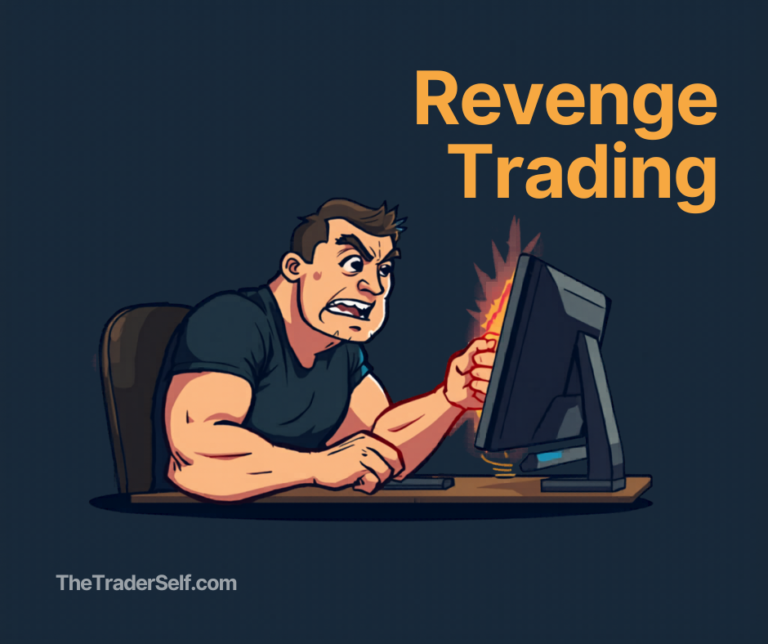
If you want to go deeper on one of the most destructive emotional patterns specifically, the next post covers How to Stop Revenge Trading in detail, including the exact cycle it follows and the techniques that interrupt it before it damages your account.
If you are serious about understanding your emotional patterns in trading, Edgewonk and TraderSync are the two tools built specifically for tracking the psychological side of your performance, not just your P and L.